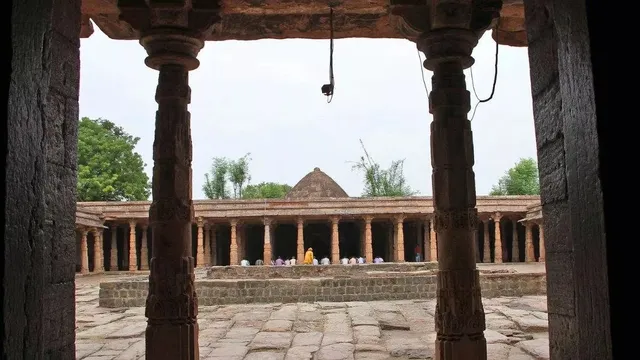

Fresh details have emerged in the long-running dispute over Bhojshala in Dhar, Madhya Pradesh, after the Archaeological Survey of India (ASI) referenced a 15th-century inscription in its survey report. According to the report, the inscription—located at the entrance of the tomb of Abdullah Shah Changal within the complex—dates to the reign of Sultan Mahmud Khilji of the Malwa Sultanate (1436–1469 CE).
As cited in Volume IV (page 260) of the ASI’s report, lines 17–18 of the inscription state that a pre-existing religious structure with installed idols was altered and the site was later used as a mosque and shrine. The ASI has included translations of the Persian text in English and Hindi. The inscription is dated to Hijri 859 (1455 CE).
The Bhojshala site—claimed by one side as the Saraswati (Vagdevi) temple and by the other as the Kamal Maula mosque—is currently under consideration before the Indore Bench of the Madhya Pradesh High Court. In 2024, ASI conducted a 98-day scientific survey and submitted a 2,189-page report. The High Court has sought objections from both parties, with the next hearing scheduled for March 16.
The ASI report also notes architectural elements within the complex—such as carved pillars and fragments—that, according to the survey, reflect temple-style motifs and appear to have been reused in later construction. Some sculptural panels on window frames are described as relatively intact, while certain pillar carvings are reported as damaged.
Reactions have been mixed. A retired ASI official from Dhar stated that the report indicates structural changes over time. A petitioner representing the temple side described the inscription as significant evidence supporting their claim. Conversely, a representative of the Kamal Maulana Welfare Committee said earlier ASI surveys from 1903–1904 had identified the site as a mosque and indicated they would file objections to the latest findings.
Separately, the issue of bringing back the Vagdevi (Saraswati) idol—currently housed in a London museum—was raised in the Madhya Pradesh Assembly. The state’s culture department said correspondence on the matter is ongoing. The idol was reportedly taken to the UK in 1930.
The court proceedings will determine how the ASI findings are weighed amid competing historical claims.